
Technical hiring
Assess how engineers think, not just what they say.
Scoutly runs the first technical round for you: live coding, system design on a whiteboard and the questions around them, with follow-ups on every choice. Your engineers review the evidence instead of running the same screen again.
Technical depth usually arrives too late.
Most first rounds are a conversation about the CV. The real technical signal waits for later rounds, after everyone has already invested hours.
Engineer hours go to screening
Senior engineers end up running the same first screen again and again, instead of building.
Talking about code isn't writing it
A phone screen hears how a candidate describes their work. It rarely sees how they actually solve a problem.
Notes that don't compare
When different engineers run the first round, candidates get different problems, and their notes can't be read side by side.
How a technical first round runs.
One structured interview per role, with the same problems for every candidate.
- 1
Describe the role
Write the stack, the level and what matters. Scoutly drafts the questions, the coding and whiteboard tasks, and the scoring criteria. Edit anything before it goes live.
- 2
Mix the formats
Combine open questions with live coding in the editor behind VS Code (14 languages) and system design on a whiteboard, in one interview.
- 3
Candidates work, Scoutly follows
Scoutly watches the solution take shape and asks about the choices behind it, the way a good interviewer would.
- 4
Review the evidence
A score for every answer, with strengths and areas for improvement, the transcript, and the code and drawing in the report.
Same first question, a follow-up for each answer.
The question every candidate got, one candidate's answer, and the follow-up Scoutly asked next.
Scoutly demo workspace · Senior Backend Engineer assessment, Lumen Freight (a fictional company)
Lumen Freight and its candidates are test data from our demo workspace. The follow-up was generated from the answer, not scripted.
Scoutly · question
Describe a challenging problem you solved with Node.js and PostgreSQL.
Candidate · answer
A race condition was double-booking delivery vehicles. I fixed it with SELECT FOR UPDATE.
Scoutly · follow-up
Did that locking cause bottlenecks or deadlocks as traffic grew?
What your team receives for every candidate.
Screens from the Scoutly demo workspace, with test candidates.
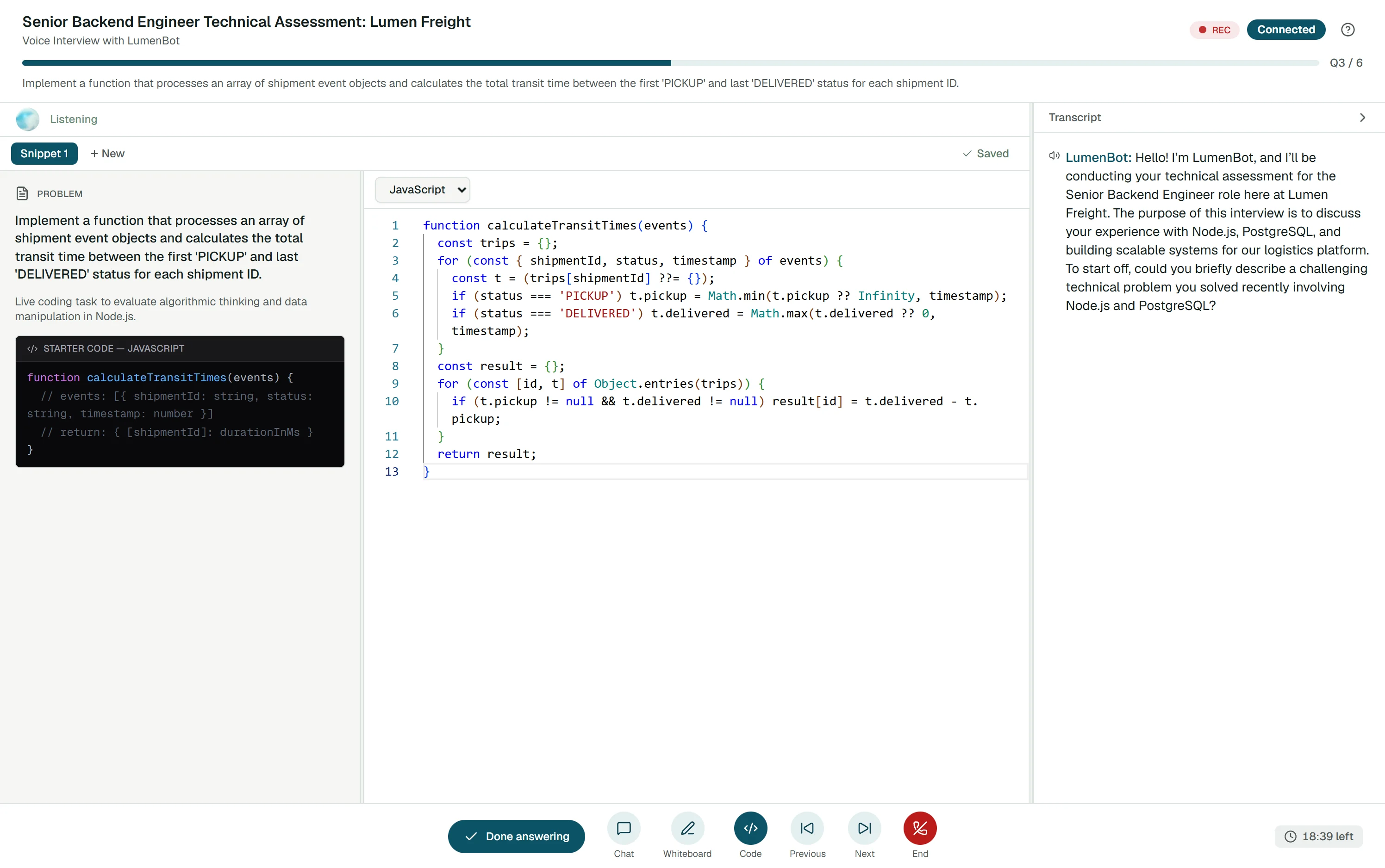
Live coding, observed
The candidate writes the solution in the editor while Scoutly follows it and asks about the approach.
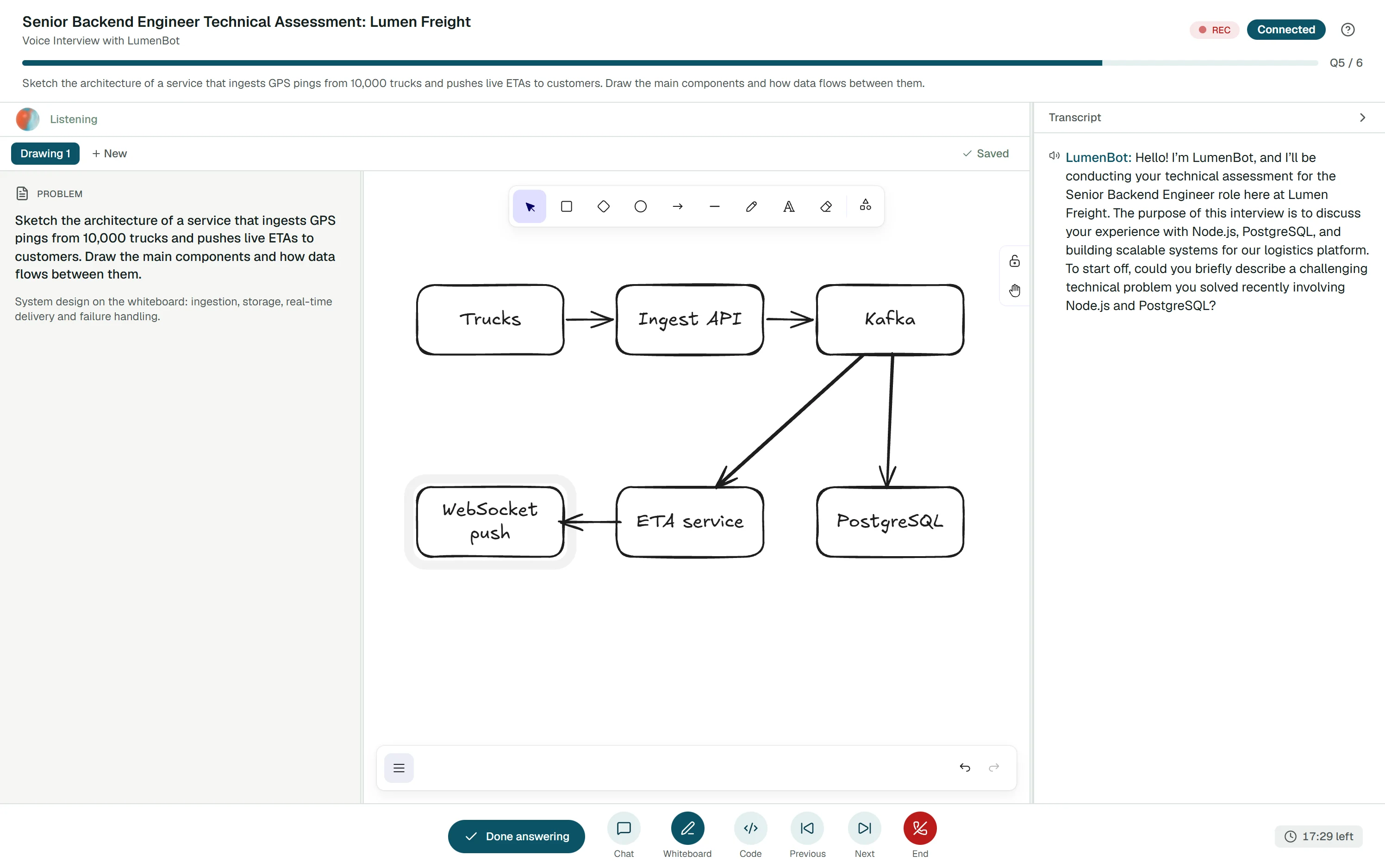
System design on a whiteboard
Candidates sketch the architecture and talk it through. The drawing is analysed in their report.
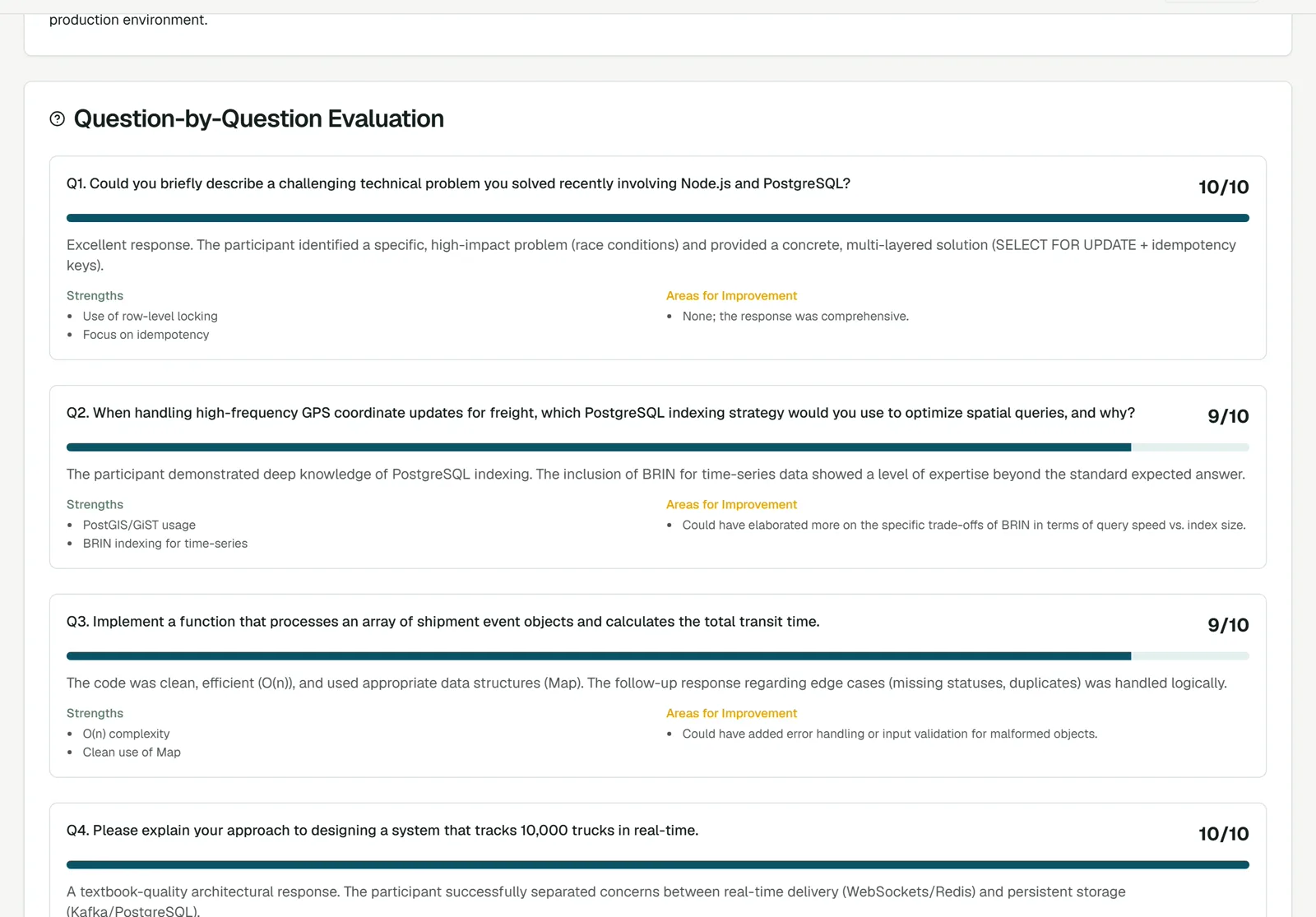
A score for every answer
Each answer is rated against your criteria, with the reasoning, the strengths and the areas for improvement.
What is measured, and how.
Every score comes with a reason your engineers can check against the transcript, the code and the drawing.
Your criteria
The generator proposes criteria from your brief. For the demo assessment above: Node.js proficiency, database design and optimisation, system architecture, and problem solving and code quality. Edit or replace them.
Scored answer by answer
Each answer, including coding and whiteboard work, is scored against the criteria with a written reason.
Reasoning, not just results
Follow-up questions probe the choices behind a solution, so the report shows how a candidate thinks, not only where they ended up.
The same problems for everyone
Every candidate for the role gets the same structured interview, so results can be compared side by side.
People decide
Scoutly gives your team structured evidence. Who moves to the next round is always your decision.
Integrity controls for remote assessments.
Turn them on per interview: pasted text is blocked, tab switches and full-screen exits are logged, and the shared screen is reviewed for AI tools afterwards. Every event lands on a timeline next to the question being answered.
Questions from technical hiring teams.
Which programming languages are supported?
The coding editor is the one behind VS Code, with 14 languages to choose from.
Does Scoutly see the code as it's written?
Yes. Scoutly follows the solution as it takes shape and asks about the choices behind it, like an interviewer watching over the candidate's shoulder.
Can I test system design?
Yes. Add a whiteboard question: the candidate sketches the architecture and talks it through while Scoutly asks about the trade-offs. The drawing is analysed in the report.
Can I mix technical and behavioural questions?
Yes. One interview can combine open questions, multiple choice, coding and whiteboard questions, in the order you choose.
How do you stop candidates from pasting code from elsewhere?
With integrity controls on, pasted text is blocked, tab switches are logged, and the shared screen is reviewed for AI tools after the interview. Every event is shown on a timeline for your team to judge.
What does a candidate need?
A computer with Chrome, a camera and a microphone. Phones and tablets aren't supported, because the interview uses screen sharing.
Does Scoutly decide who gets hired?
No. Scoutly runs the first round and gives your team a scored, explained report. People decide who moves forward.

Run the first technical round without an engineer on the call.
Scoutly is opening to a first group of hiring teams. Tell us about your roles and we'll set up your first technical assessment with you.
Request early access