
Demo walkthrough
One hiring round, start to finish.
We ran a complete first round in Scoutly's demo workspace for a fictional company, Lumen Freight: one brief, one generated interview, five test candidates. Every screen below is the product's real output.
About this demo
Lumen Freight is fictional, and the five candidates are test personas whose answers we wrote ourselves. The interview, the follow-ups, the scores and the reports are what Scoutly produced. This shows how the product works, not a hiring outcome.
The hiring context
- Company
- Lumen Freight (fictional), a freight-tracking platform
- Role
- Senior Backend Engineer: Node.js and PostgreSQL
- Goal
- A first technical round with live coding and system design
- Settings
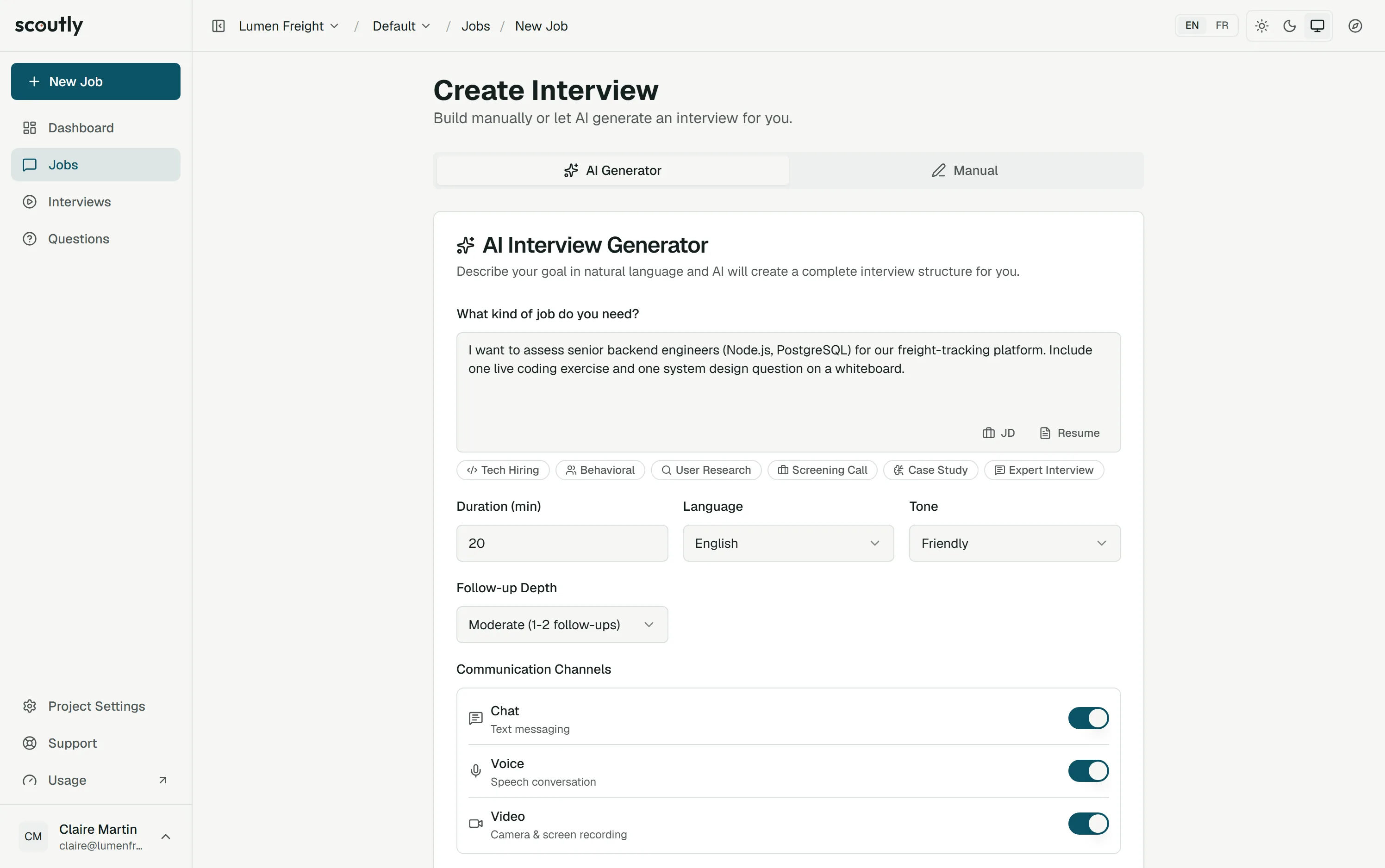
- 20 minutes, English, friendly tone, moderate follow-ups (1 to 2 per answer)
- Formats
- Voice, chat or video, at the candidate's choice
The round, step by step.
- 1
One brief
The recruiter described the role in one sentence. Scoutly turned it into a complete interview.
I want to assess senior backend engineers (Node.js, PostgreSQL) for our freight-tracking platform. Include one live coding exercise and one system design question on a whiteboard.
- 2
The generated interview
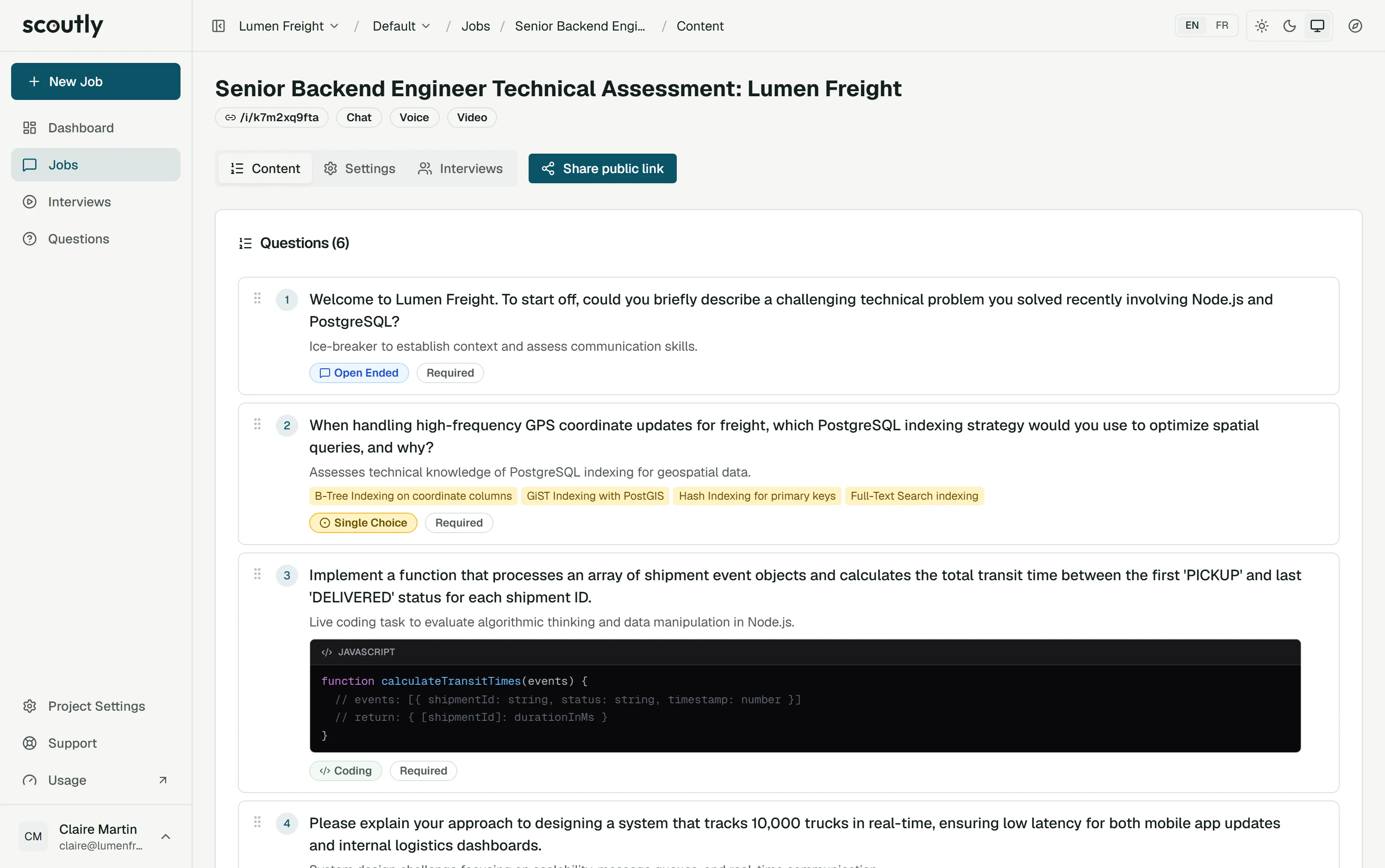
Six questions, including an opening question on a real Node.js and PostgreSQL problem, a PostgreSQL indexing choice, a coding task (total transit time per shipment, in JavaScript) and a system design for tracking 10,000 trucks in real time. Everything was reviewable and editable before going live.
- 3
Five candidates, one link each
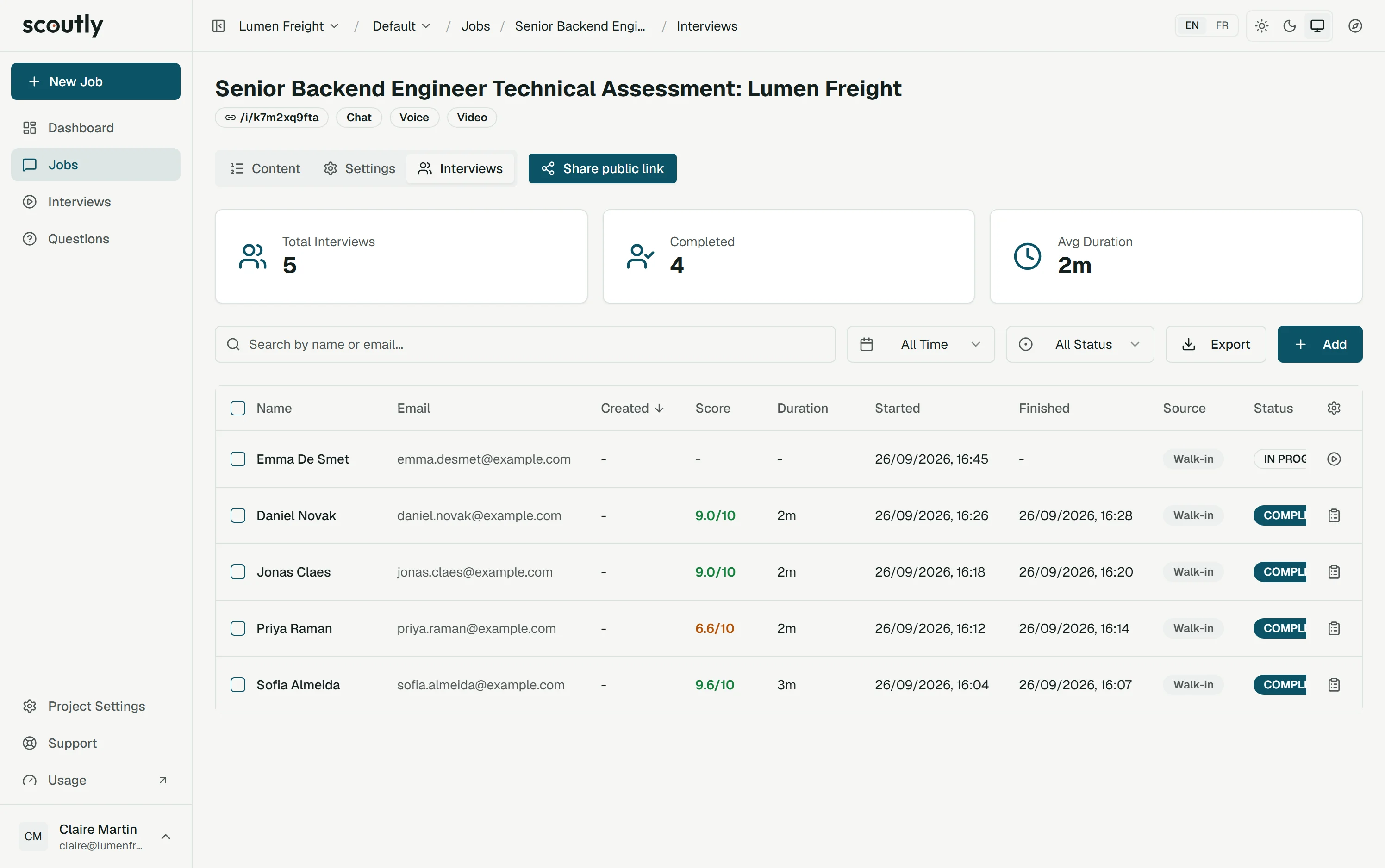
Five test candidates were added to the job. Each received a link and took the interview when it suited them.
- 4
Coding, observed
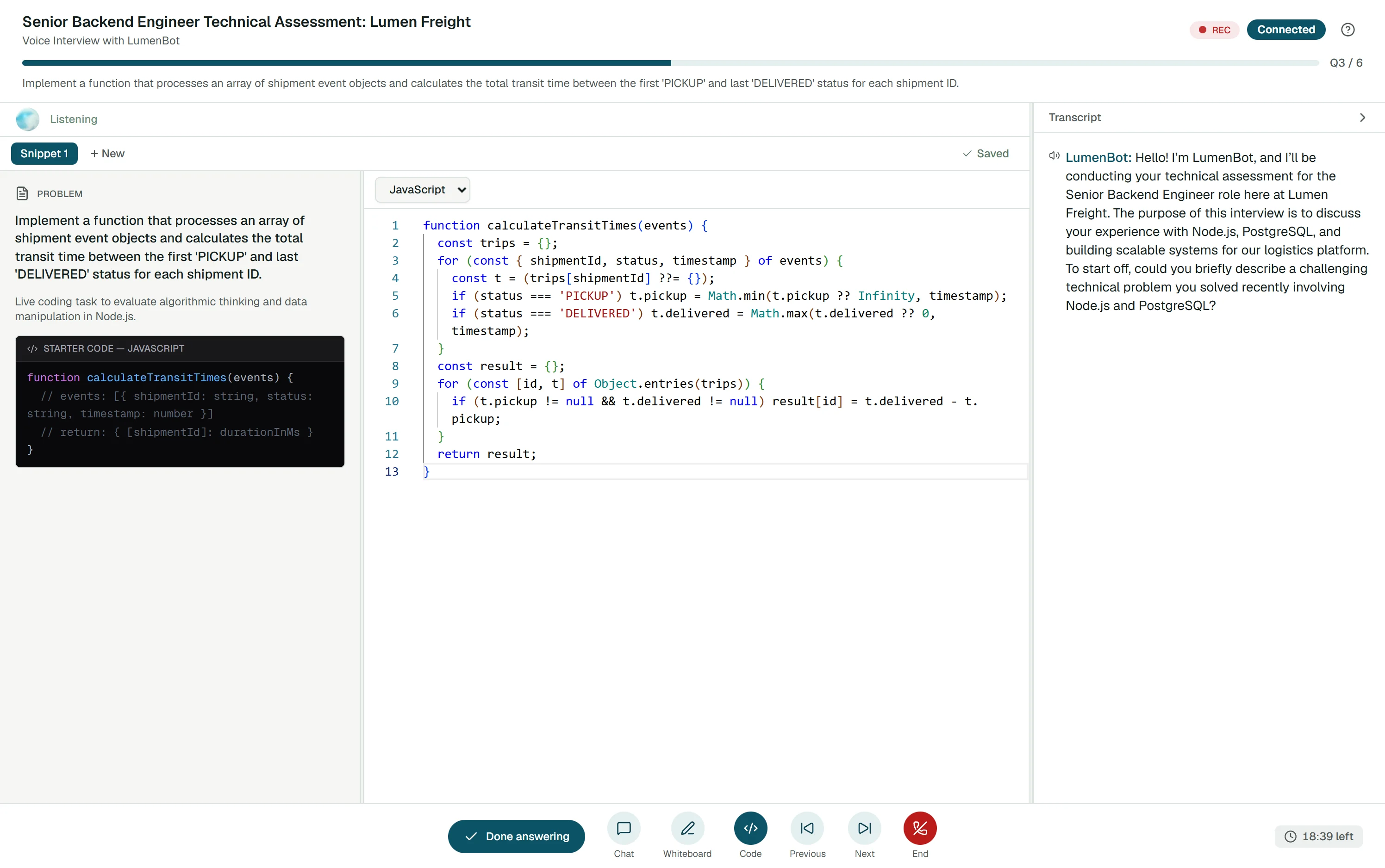
Candidates wrote the coding task in the editor while Scoutly followed the solution and asked about the choices behind it.
- 5
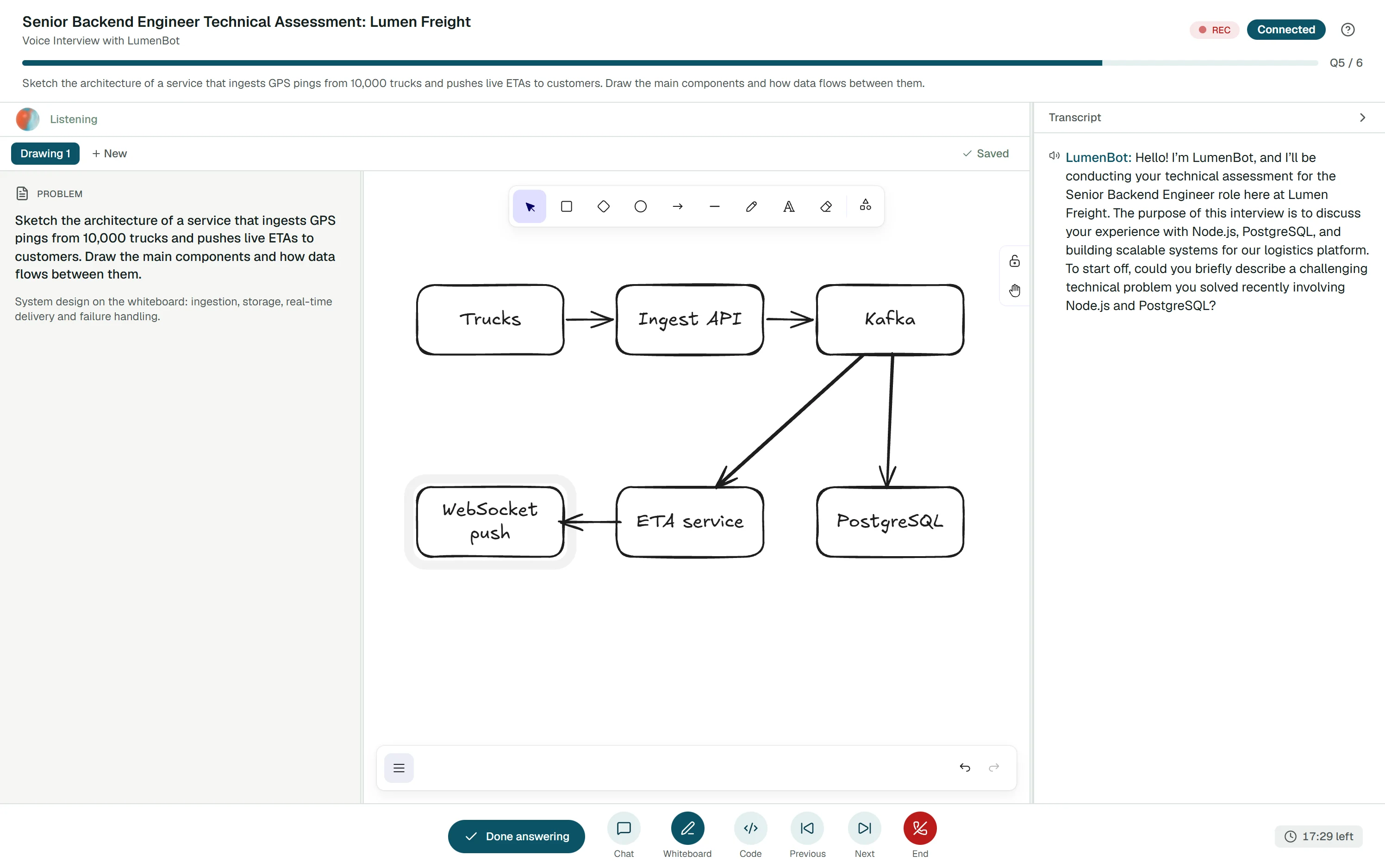
System design on the whiteboard
Candidates sketched the architecture and talked it through. The drawing is part of the report.
- 6
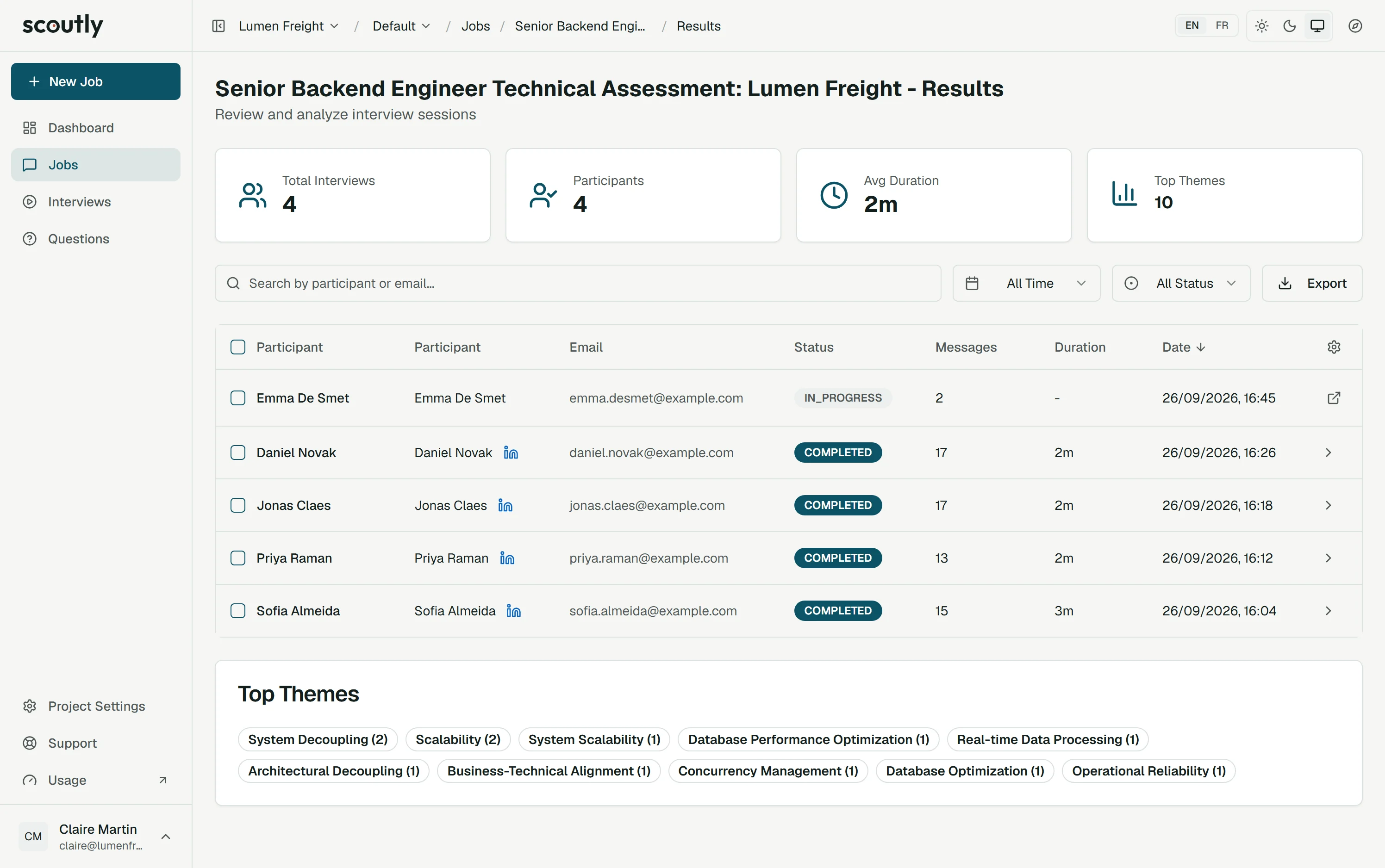
Results, side by side
Four candidates finished and one was still in progress. Scoutly also grouped themes that came up across the sessions, such as scalability and system decoupling.
- 7
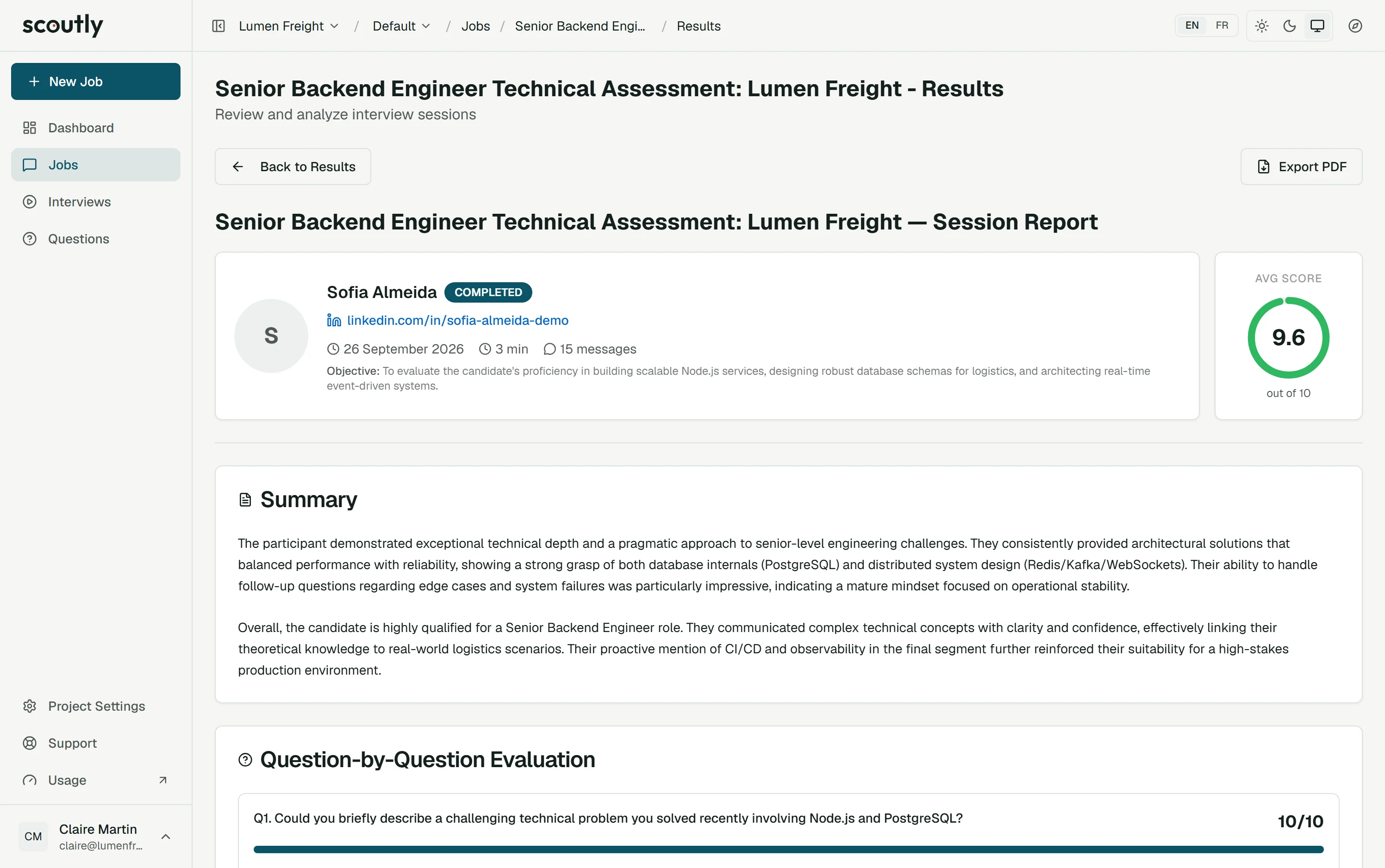
A report for every candidate
Sofia Almeida's report: a written summary, an average score of 9.6 out of 10, and a question-by-question evaluation with the reasoning for each score.
Same first question, a different follow-up for each candidate.
Asked to every candidate
Describe a challenging problem you solved with Node.js and PostgreSQL.
Sofia answered
A race condition was double-booking delivery vehicles. I fixed it with SELECT FOR UPDATE.
Scoutly asked
Did that locking cause bottlenecks or deadlocks as traffic grew?
Daniel answered
Our connection pool kept running out under load, so I moved the writes to a background queue.
Scoutly asked
What did users see on the frontend while the job was still running?
Jonas answered
Shipment updates were fighting over database locks. I decoupled the ingestion layer.
Scoutly asked
Which metrics proved lock contention was the real bottleneck?
What the round produced.
The average score on each completed report, as Scoutly calculated it.
| Candidate (test persona) | Status | Average score |
|---|---|---|
| Sofia Almeida | Completed | 9.6 / 10 |
| Daniel Novak | Completed | 9.0 / 10 |
| Jonas Claes | Completed | 9.0 / 10 |
| Priya Raman | Completed | 6.6 / 10 |
| Emma De Smet | In progress | Not scored yet |
A score is evidence for your team to read, not a decision. In a real round, the team reads each report and decides who moves forward.
How these results were measured.
Scored against the role's criteria
Each answer was scored out of 10 against the assessment criteria generated from the brief: Node.js proficiency, database design and optimisation, system architecture, and problem solving and code quality. Every score carries a written reason.
The same interview for everyone
All five candidates got the same six questions. Only the follow-ups changed, based on each answer.
Durations are not representative
The completed sessions took 2 to 3 minutes because we typed the test answers. A real interview runs for the length you set, 20 minutes here.
What we did not measure
Time saved, quality of hire or candidate satisfaction. There was no real vacancy, so there is no hiring outcome to report. We'll publish such figures only from a real customer, with their permission.
Run this round for your own role.
Scoutly is opening to a first group of hiring teams. Tell us about your roles and we'll set up your first assessment with you.
Request early access